


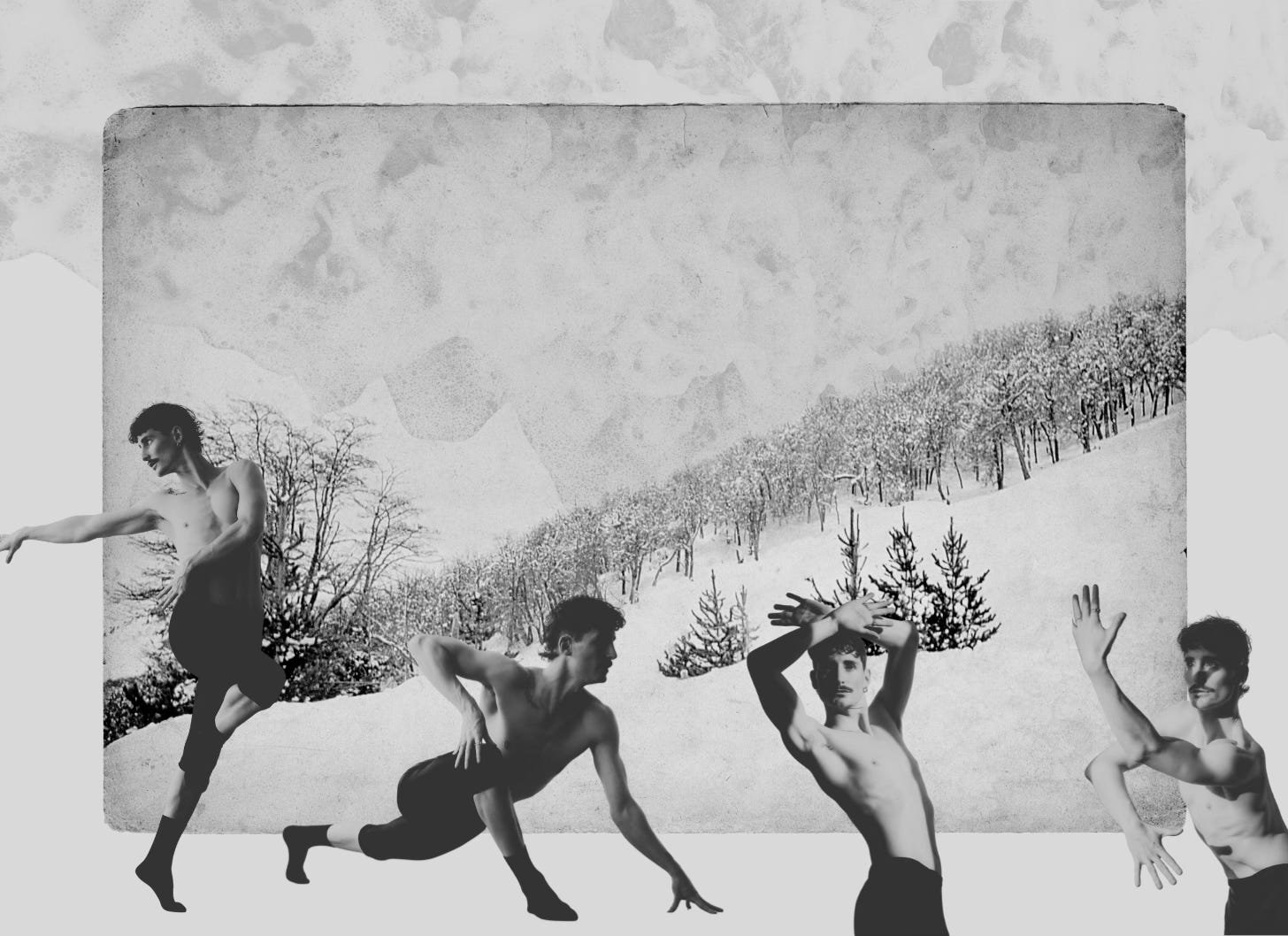
Collage by me, 2025.
In New York, we have fallen back. It’s dark all the time. Even the trees are a sunset. I actually saw the first batch of leaves in bags today, as I walked through Prospect Park. I tried to feel grateful for them. I looked at those bags so intentionally, and I said ‘WOW! Thank you, bags!” But honestly my heart wasn’t in it. I was (am) feeling anxious, listless, and bleak. This is how I find myself as I consider the idea of a ‘dancing animal’.
The idea is not mine; it’s Vonnegut’s, from an interview in Inc’s 1996 Technology issue:
“We are here on Earth to fart around … Electronic communities build nothing. You wind up with nothing. We’re dancing animals. How beautiful it is to get up and go do something [Gets up and dances a jig.]”
He is talking about computers and reasons to be wary of them. He is not directly offering advice for somatic alleviation. But it’s such a nice reminder: we are meant to be in our bodies.
It’s just so easy to forget the fact of our animalness. I do not get mad at the park turtles that they sit on rocks all summer and now they are sleeping underwater and breathing through their butts1. I am not mad at the swans for being bitchy and beautiful about their babies. I am not even mad at the leaves for needing to go away for a little bit.
But I am mad at myself for being seasonal: for having days where the best I can do is attend to the bare necessities. I have more in common with a daylily, a cherry blossom, a barn swallow over the Sahara. And yet, I treat myself like a computer: an object designed to do the same thing, in the same way, any time I ask.
There is a reasonable amount of writing and discussion about how the computer as metaphor for the brain is flawed. As early as the 1950s, neuroscientist Karl Lashly wrote:
Descartes was impressed by the hydraulic figures in the royal gardens, and developed a hydraulic theory of the action of the brain. We have since had telephone theories, electrical field theories and now theories based on computing machines and automatic rudders. I suggest we are more likely to find out about how the brain works by studying the brain itself, and the phenomena of behaviour, than by indulging in far-fetched physical analogies.
Honestly, TYSM Karl! I love hearing this. Because my brain is a terrible computer. But it’s a pretty marvelous brain. It’s the brain of a dancing animal—a dancing animal that really loves to dance, at that. And just one last thought here my friends, I have literally never seen a computer dance.
So, what to do with this?
This week’s mission is an invitation:
When you are wondering what you should do, or if you should do more, or if this or that is enough, answer the question by asking a different one: what would a dancing animal do? And then let the answer come up at you from the ground, or from your stomach, or sideways from the air and just go with that—whatever a dancing animal would do, do that.
I’ll be bopping over here,
Lucy
It’s called ‘cloacal respiration’. Here’s a fun article about it.